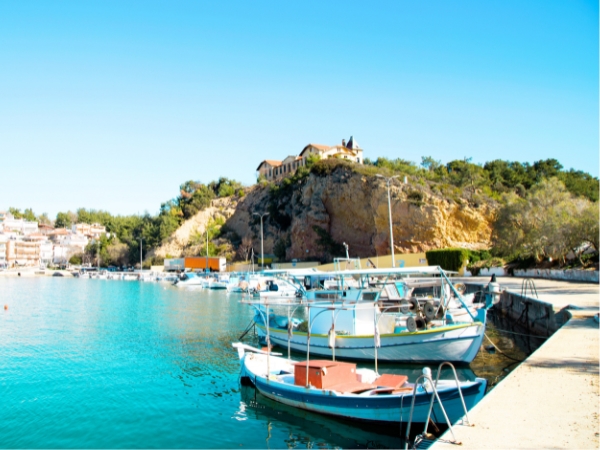
Greece is a country perfect for a driving adventure. While the turquoise waters of the Aegean and the ancient ruins of the Peloponnese are the primary draws for many tourists, the true heart of the country is often found at the end of a winding mountain road or a dusty coastal track.
Driving in Greece offers a sense of liberation that is difficult to replicate through any other form of travel. It allows you to bypass the rigid schedules of intercity buses and the crowded tourist hubs, granting access to secluded coves in Halkidiki, the dramatic monasteries of Meteora, and the rugged, stone-built villages of the Mani Peninsula.
However, for many tourists, the prospect of driving in a foreign land can be daunting. Greek roads have long held a reputation for being chaotic, characterised by narrow lanes, steep inclines, and a driving method that prioritises assertiveness over caution. To safely navigate this Mediterranean gem, you need to understand the local driving rules and culture.
For a tourist, being informed is the best way to transition from a nervous navigator to a confident driver, allowing you to focus on the spectacular scenery rather than the stress of the road. This article serves as a comprehensive guide for tourists, ensuring your journey across the Greek landscape is as safe and as smooth as possible.
Before you can get behind the wheel and start your adventure, there are several local requirements that you have to secure to legally drive and rent a car. These stipulations are straightforward, but strictly enforced at rental counters and police checkpoints.
If you are a citizen of the European Union or the European Economic Area, your valid driving licence is fully recognised and sufficient. However, if you are arriving from outside the EU, Greek law mandates that you need to present an International Driving Permit (IDP) alongside your licence. Aside from these documents, you should also always carry your passport and the original rental agreement in the vehicle at all times.
Furthermore, rental agencies are now required to link your driving credentials with your European Travel Information and Authorisation System (ETIAS) or Schengen visa details. This digital registry is designed to streamline the processing of any traffic violations incurred during your stay. Make sure to ask the agency about this when you arrive at the rental desk.
While the legal driving age in Greece is 18, most rental companies set their own minimum age requirements, typically between 21 and 23. Drivers under the age of 25 often face a Young Driver Surcharge, which is a daily fee added to the base rate. Furthermore, those over 75 years old may be required to provide a medical certificate or purchase additional insurance coverage.

Greece drives on the right-hand side of the road and overtakes on the left. Aside from this basic rule, you need to understand more official laws to avoid fines and other penalties. The government has recently implemented updates to the National Traffic Code, shifting towards stricter digital enforcement of regulations to align with European safety standards.
One of the most significant changes introduced is the widespread implementation of the 30 km/h speed limit in residential and high-pedestrian urban areas. On main urban arteries, the limit remains 50 km/h, while expressways typically allow for 90 to 110 km/h. On the national motorways, the maximum speed is 130 km/h, though this can be reduced via electronic overhead signs during inclement weather or heavy traffic.
One of the most confusing driving rules in Greece involves roundabouts. Unless there is a Yield or Give Way sign at the entrance, the vehicle entering the roundabout has priority. This is the default setting in Greece, which is the opposite of the convention in other countries. While many modern roundabouts in major cities now use signs to give priority to those already inside the circle, you must always look for the signage. If no sign is present, prepare to stop for vehicles entering from your right.
The Greek authorities have also intensified their crackdown on safety violations. Seatbelts are mandatory for all passengers, and children under the age of 12 must be seated in appropriate child restraints. The use of a handheld mobile phone while driving is strictly prohibited and carries a heavy fine, accompanied by the confiscation of the driver's licence.
Perhaps most importantly, Greece has very rigid drunk driving laws. The legal blood alcohol limit is 0.05% for experienced drivers, but for novices, those who have held a licence for less than two years, and motorcyclists, the limit is a mere 0.02%, which effectively means a zero-tolerance policy.
While the official traffic laws provide the framework, they are only half the story. The unwritten rules of driving in Greece dictate the actual flow of traffic. To drive successfully here, you must understand the local rhythm, from the road language used to the driving etiquette.
Communication on Greek roads uses non-verbal language, which can be misinterpreted by tourists. For instance, hazard lights are used for a variety of reasons beyond a mechanical breakdown. You will see drivers engage their hazard lights to signal they are double-parking to pick up coffee, warning of a sudden traffic jam ahead, or indicating that they are about to perform a difficult manoeuvre.
Similarly, a flash of the headlights from an oncoming vehicle doesn't usually mean please go ahead. More often, it is a warning that there is a police speed trap ahead or that the driver intends to take the right-of-way regardless of the formal rules. Horns are also commonly used to alert others to your presence or to communicate, such as signalling to a driver who is not moving when a traffic light has turned green.
One of the most common sights on Greek national roads is the use of the hard shoulder. On single-lane highways, slower drivers will often move halfway onto the paved shoulder to allow faster vehicles to overtake without crossing into the oncoming lane. While technically illegal, this is considered a courtesy. If a driver behind you flashes their headlights, they are likely asking you to move over so they can pass.
In rural areas and on the islands, the driving culture is dictated by the environment. Roads are often narrow enough that two cars cannot pass simultaneously, requiring one driver to reverse to a wider point. It is customary for the driver closer to a turnout or the one driving downhill to yield.
Furthermore, livestock such as goats and sheep are a common fixture on Greek roads. These animals have the de facto right of way, and attempting to honk your way through a flock will rarely be successful. Patience is essential in these settings, as the pace of life and driving slows down significantly once you leave the major motorways.

Driving in Greece is an experience that rewards prepared travellers. By familiarising yourself with the local driving rules, you can avoid the pitfalls that catch many tourists off guard. Remember that while the infrastructure is modernising, the heart of Greek driving remains rooted in a culture of assertiveness and adaptability.
The decision to rent a vehicle and explore the Greek mainland or its sprawling archipelagos is often the difference between a standard holiday and a genuine odyssey. The minor stresses of navigating a foreign road system are a small price to pay for the unparalleled access a car provides.
From the sun-drenched olive groves of the Peloponnese to the dramatic coastal cliffs of the Ionian Islands, the best of Greece is found just beyond the reach of the tour bus. Now that you are equipped with the knowledge to drive safely and legally, nothing is stopping you. Rent a car from Final Rentals today and begin your own Greek adventure.